


Transformer
We have transformers of various specifications and models, no matter how many you want to convert, and you can buy them at the lowest price! Contact us now!
What Is Transformer
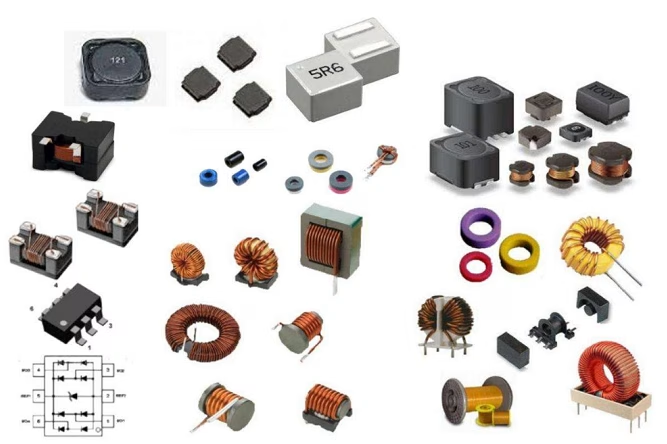
A transformer is a device that uses the principle of electromagnetic induction to change AC voltage. The main components are a primary coil, a secondary coil, and an iron core (magnetic core). The main functions are: voltage conversion, current conversion, impedance conversion, isolation, voltage stabilization (magnetic saturation transformer), etc. It can be divided into: power transformer and special transformer (electric furnace transformer, rectifier transformer, power frequency test transformer, voltage regulator, mining transformer, audio transformer, intermediate frequency transformer, high frequency transformer, impact transformer, instrument transformer, electronic transformer , Reactors, transformers, etc.).
Types of Transformer
Transformers come in a wide variety of types, each designed for specific voltage levels, frequency ranges, power ratings, and application requirements.
Power Transformer Power transformers are used to transfer electrical energy between circuits by stepping voltage up or down while maintaining the same frequency. They are the backbone of electrical power distribution systems, used in power plants, substations, and industrial facilities. Large power transformers handle voltages from tens of kilovolts up to hundreds of kilovolts, while smaller versions are used in household appliances and consumer electronics power supplies.
Audio Transformer Audio transformers are designed to operate in the audible frequency range (20Hz to 20kHz). They are used for impedance matching between audio components, signal isolation, and balancing unbalanced audio signals. Common applications include microphone inputs, line-level interfaces, public address systems, guitar amplifiers, and professional audio equipment. Audio transformers must maintain flat frequency response and low distortion across the entire audio band.
Intermediate Frequency (IF) Transformer IF transformers are tuned transformers designed to operate at specific intermediate frequencies used in superheterodyne radio receivers, typically 455kHz for AM radios and 10.7MHz for FM radios. They provide selectivity and gain at the IF stage, filtering out unwanted signals. They are a key component in radio and TV receivers, radar systems, and communication equipment.
High Frequency Transformer High frequency transformers operate at frequencies from tens of kilohertz up to several megahertz, far above the 50/60Hz of standard power transformers. They are the core component in switched-mode power supplies (SMPS), DC-DC converters, and inverters. Because higher frequencies allow smaller core sizes, high frequency transformers are compact and lightweight despite handling significant power levels. They are used in laptop chargers, LED drivers, telecom power supplies, and renewable energy systems.
RF Transformer RF transformers operate at radio frequencies ranging from a few megahertz to several gigahertz. They are used for impedance matching, signal coupling, and balanced-to-unbalanced (balun) conversion in RF circuits. Applications include antennas, transceivers, RF amplifiers, and signal processing equipment. RF transformers must maintain consistent performance with minimal insertion loss across their specified frequency range.
Isolation Transformer Isolation transformers have a 1:1 turns ratio, meaning input and output voltages are equal. Their primary purpose is to electrically isolate the primary and secondary circuits, breaking the direct conductive path while still allowing AC power to pass. This protects equipment and operators from electric shock, eliminates ground loops in audio/video systems, and reduces the impact of electrical noise. They are widely used in medical equipment, laboratory instruments, marine applications, and sensitive electronic systems.
Instrument Transformer Instrument transformers are precision transformers used to measure high voltages and currents safely by stepping them down to levels suitable for measuring instruments and protective relays. There are two main types: Current Transformers (CT), which measure large AC currents, and Voltage Transformers (VT) or Potential Transformers (PT), which measure high AC voltages. They are essential in power metering, protection relays, and monitoring systems in power distribution networks.
Toroidal Transformer Toroidal transformers use a donut-shaped (toroidal) core, which provides a closed magnetic path with very low leakage flux. Compared to traditional EI-core transformers, toroidal transformers are more efficient, generate less electromagnetic interference (EMI), produce less mechanical hum, and are more compact for the same power rating. They are popular in high-quality audio amplifiers, medical equipment, and sensitive instrumentation where low noise and high efficiency are important.
Pulse Transformer Pulse transformers are designed to transmit rectangular electrical pulses with minimal distortion. They must accurately reproduce the sharp rising and falling edges of pulse waveforms. They are used in digital communication systems, gate drive circuits for power semiconductors (IGBTs, MOSFETs), radar systems, and data transmission interfaces such as Ethernet (where pulse transformers provide isolation and impedance matching on the physical layer).
Auto-Transformer An auto-transformer uses a single winding that acts as both the primary and secondary, with the output taken from a tap point along the winding. Because part of the winding is shared, auto-transformers are more compact and efficient than two-winding transformers for small voltage conversion ratios. However, they do not provide electrical isolation between input and output. They are used as voltage regulators, motor starters, and in applications requiring small voltage adjustments such as 110V to 120V conversions.
Rectifier Transformer Rectifier transformers are specially designed to supply AC power to rectifier circuits that convert AC to DC. They are built to handle the harmonic currents generated by rectifier loads and are used in electroplating plants, electrolytic processes, DC motor drives, traction systems, and industrial DC power supplies. They often have multiple secondary windings with specific phase relationships to reduce harmonic distortion.
Planar Transformer Planar transformers use flat, PCB-based windings instead of traditional wound wire coils. The primary and secondary windings are etched directly onto PCB layers, with a low-profile ferrite core sandwiched between them. This construction results in extremely low profile, excellent thermal performance, high power density, and very tight manufacturing tolerances. Planar transformers are increasingly used in high-frequency power converters, server power supplies, and aerospace electronics where size and weight are critical.
Our Advantage
Our company is an distributor for many transformer manufacturers including Hammond, Murata, Pulse, TE Connectivity, Triad, White-Rodgers & more.
Help
If you have questions about the electronic components we provide, or you do not find the product you want, reach us here. We will provide you with corresponding products according to your needs.
