


Relay
We are distributors of multiple brands of relays and have a large stock, therefore, you can find any relay you want at OrinewPCB! Contact us now!
What Is Relay
A switch is a high-frequency power conversion device and a type of power supply. Its function is to convert a level of voltage into the voltage or current required by the user through different forms of architecture. The input of the switching power supply is mostly AC power or DC power, and the output is mostly equipment that requires DC power.
Use of Relay
Relay is an automatic switching element with isolation function. It is widely used in remote control, telemetry, communication, automatic control, mechatronics and power electronic equipment. It is one of the most important control elements.
Types of Relay
Relays are available in many different types, each designed for specific switching requirements, operating environments, and circuit applications.
General Purpose Relay General purpose relays are the most widely used relay type, designed for a broad range of everyday switching applications. They typically operate on standard coil voltages (5V, 12V, 24V DC or AC) and can switch moderate loads up to several amps. They are found in home appliances, industrial control panels, automotive accessories, and consumer electronics.
Automotive Relay Automotive relays are designed to meet the demanding requirements of vehicle environments, including wide temperature ranges, vibration, humidity, and exposure to chemicals. They are used to control high-current loads such as headlights, horns, fuel pumps, cooling fans, and starter motors, allowing low-current vehicle control systems to safely switch high-power circuits.
Reed Relay Reed relays use a pair of ferromagnetic reeds sealed inside a glass tube filled with inert gas. When a magnetic field is applied via a surrounding coil, the reeds close to complete the circuit. Reed relays offer extremely fast switching speeds, long mechanical life (up to billions of operations), low contact resistance, and excellent isolation. They are ideal for test and measurement equipment, medical devices, and telecommunications switching matrices.
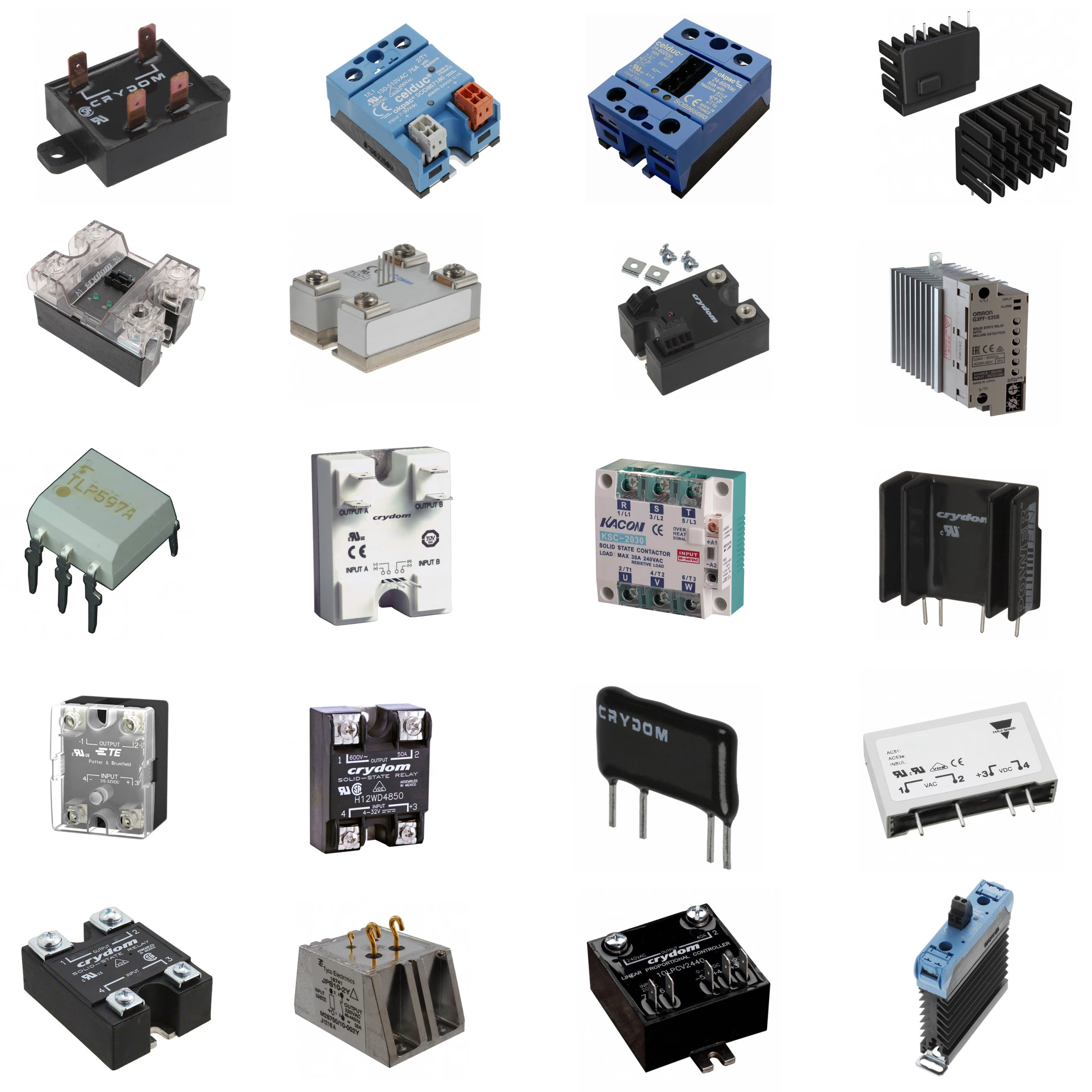
Solid State Relay (SSR) Unlike electromechanical relays, solid state relays have no moving parts. They use semiconductor devices (such as thyristors, triacs, or MOSFETs) to switch the load circuit. SSRs offer silent operation, faster switching, longer service life, no contact arcing, and resistance to vibration and shock. They are widely used in temperature controllers, industrial automation, medical equipment, and anywhere that noise-free, maintenance-free switching is required.
High Frequency & RF Relay RF relays are designed to switch radio frequency signals with minimal signal loss and distortion. They maintain consistent impedance (typically 50Ω) across the switching path and are used in antenna switching, signal routing in test systems, telecommunications infrastructure, and radar equipment. Key specifications include insertion loss, isolation, and VSWR (Voltage Standing Wave Ratio).
Safety Relay Safety relays are specifically designed for use in safety-critical systems where the failure of the relay could result in injury or equipment damage. They feature forcibly guided contacts (also called mechanically linked contacts), which ensure that normally open and normally closed contacts can never be closed simultaneously. Safety relays are used in emergency stop circuits, light curtains, two-hand control systems, and machine guarding applications, and are typically compliant with IEC 61810 and ISO 13849 standards.
Timing Relay Timing relays introduce a time delay between the activation of the coil and the switching of the contacts. They are available in on-delay, off-delay, single-shot, and repeat-cycle configurations. Timing relays are used in motor starters, conveyor systems, lighting controls, HVAC systems, and any application requiring a controlled time sequence of operations.
Industrial Relay Industrial relays are built for heavy-duty, high-reliability operation in demanding factory and plant environments. They typically feature plug-in designs for easy replacement, LED status indicators, mechanical flags, and high contact ratings. They are used in PLC output circuits, machine control panels, power distribution systems, and process automation equipment.
Low Signal Relay Low signal relays are designed to switch very small voltages and currents, typically in the millivolt and microamp range, without introducing significant contact resistance or noise. They are used in sensitive instrumentation, medical diagnostic equipment, communications systems, and data acquisition circuits where signal integrity is paramount.
Latching Relay Latching relays (also called bistable relays) maintain their switched position even after the coil power is removed. They require a pulse to switch in one direction and another pulse to switch back. This makes them ideal for energy-saving applications where the relay must hold its state without continuous power consumption, such as smart metering, building automation, and battery-powered systems.
Our Advantage
Our company is an distributor for many relay manufacturers including IXYS, KEMET, Omron, Panasonic, Phoenix Contact, Schneider Electric, Sensata, TE Connectivity, Teledyne & more. We stock a large variety of relays including Automotive, General Purpose, High Frequency & RF, Industrial, Low Signal, Reed, Safety, Timing and Solid State Relays.
Help
If you have questions about the electronic components we provide, or you do not find the product you want, reach us here. We will provide you with corresponding products according to your needs.
