


Fuse
We are a fuse dealer of many big brands, and have a large inventory, you can find any brand you want here! Contact us now!
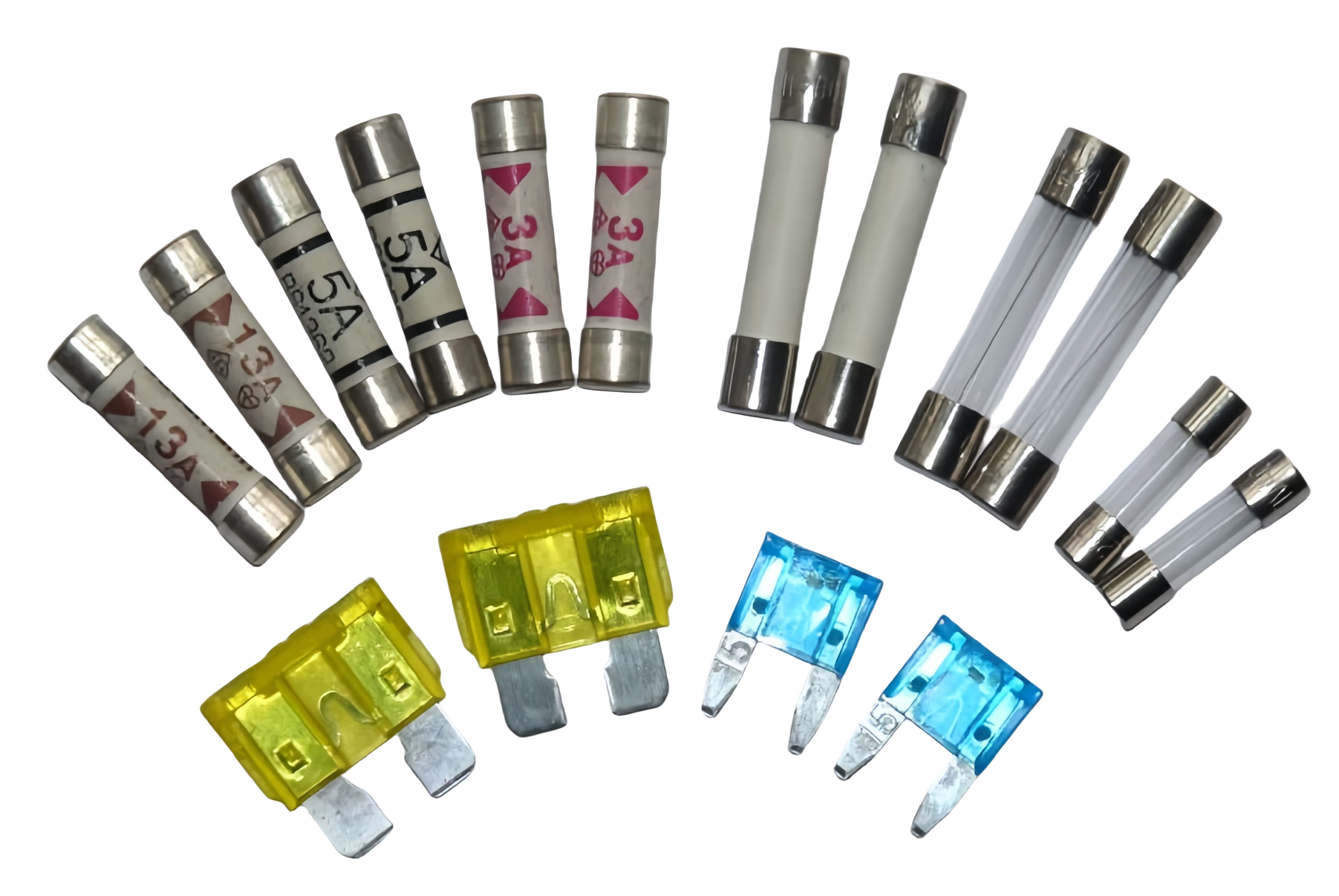
What Is Fuse
A fuse is a device designed to stop current flow when it exceeds a certain limit (overcurrent protection). The devices works by creating an opening in a material situated between two end terminals. The material will melt (blow) from an increase in heat generated by the device as the current flow changes. The amount of time it takes the device to blow is often defined as fast or slow-blow.
Types of Fuse
Fuses are available in many different types and configurations, each suited to specific voltage levels, current ratings, response speeds, and application environments.
Cartridge Fuse Cartridge fuses are cylindrical fuses enclosed in a glass or ceramic tube with metal end caps. They are one of the most common fuse formats, available in a wide range of current and voltage ratings. Glass body versions allow visual inspection of the fuse element, while ceramic body versions are used for higher voltage and higher breaking capacity applications. Common sizes include 5×20mm and 6.3×32mm.
Blade Fuse (Automotive Fuse) Blade fuses, also known as spade or plug-in fuses, are the standard fuse type used in automotive applications. They feature a plastic body with two prongs that plug directly into a fuse box. They are color-coded by current rating for easy identification, with common ratings ranging from 1A to 40A. Types include Mini, Standard (ATO/ATC), Maxi, and Low-Profile Mini blade fuses, each suited to different fuse box formats in cars, trucks, and motorcycles.
Resettable Fuse (PTC Fuse / PolySwitch) Resettable fuses, also called PTC (Positive Temperature Coefficient) fuses or polyfuses, are made from a conductive polymer material. When overcurrent occurs, the device heats up, dramatically increasing its resistance and limiting current flow. Once the fault is removed and the device cools down, it resets automatically to its low-resistance state. Resettable fuses are ideal for applications where frequent fuse replacement is impractical, such as USB ports, battery packs, telecommunications equipment, and portable electronics.
Surface Mount Fuse (SMD Fuse) SMD fuses are compact fuses designed for surface mount assembly directly onto PCBs. They are available in standard chip sizes such as 0402, 0603, 0805, 1206, and 2410. SMD fuses are widely used in modern consumer electronics, smartphones, laptops, and IoT devices where board space is limited and automated assembly is required. They are available in fast-acting and slow-blow versions.
Through-Hole Fuse Through-hole fuses are leaded components designed to be inserted into PCB holes and soldered in place. They provide a secure, reliable connection and are used in applications where SMD mounting is not practical or where the fuse needs to be accessible for replacement. They are common in industrial electronics, power supplies, and control boards.
Slow-Blow Fuse (Time-Delay Fuse) Slow-blow fuses are designed to tolerate brief current surges without blowing, making them suitable for circuits with motors, transformers, or capacitors that draw high inrush currents at startup. They only blow when an overcurrent condition is sustained for a longer period. They are widely used in HVAC equipment, motor control circuits, power supplies, and industrial machinery.
Fast-Acting Fuse (Quick-Blow Fuse) Fast-acting fuses respond almost instantly to overcurrent conditions, providing rapid protection for sensitive components that cannot tolerate even brief exposure to excess current. They are commonly used in precision instruments, semiconductor circuits, power supplies, and electronic test equipment where fast response is critical to prevent component damage.
High Voltage Fuse High voltage fuses are designed to operate safely at voltages from several kilovolts up to hundreds of kilovolts. They are used in power distribution systems, transformers, switchgear, and utility infrastructure. They must be capable of safely interrupting very high fault currents and are typically housed in robust ceramic or composite bodies.
Industrial Fuse Industrial fuses are heavy-duty fuses designed for use in commercial and industrial power systems, typically operating at voltages up to 600V AC or higher and current ratings from tens to thousands of amps. Common formats include Class J, Class R, Class L, and Class T fuses, each with defined physical dimensions and breaking capacities. They protect motors, transformers, feeders, and industrial control equipment.
Specialty Fuse Specialty fuses cover a range of application-specific designs, including subminiature fuses for compact electronics, high-breaking-capacity fuses for fault-prone circuits, and fuses designed for specific standards such as UL, IEC, or military specifications. This category also includes fuse arrays and fusible resistors, which combine resistance and overcurrent protection in a single component.
Our Advantage
Our company is an distributor for many fuse manufacturers including Bel, Bourns, Eaton, Littelfuse, Schurter & more. We stock many types of fuses including Automotive, Circular, Electrical, Industrial, Resettable, Surface Mount, Specialty, Through Hole and many more.
Help
If you have questions about the electronic components we provide, or you do not find the product you want, reach us here. We will provide you with corresponding products according to your needs.
