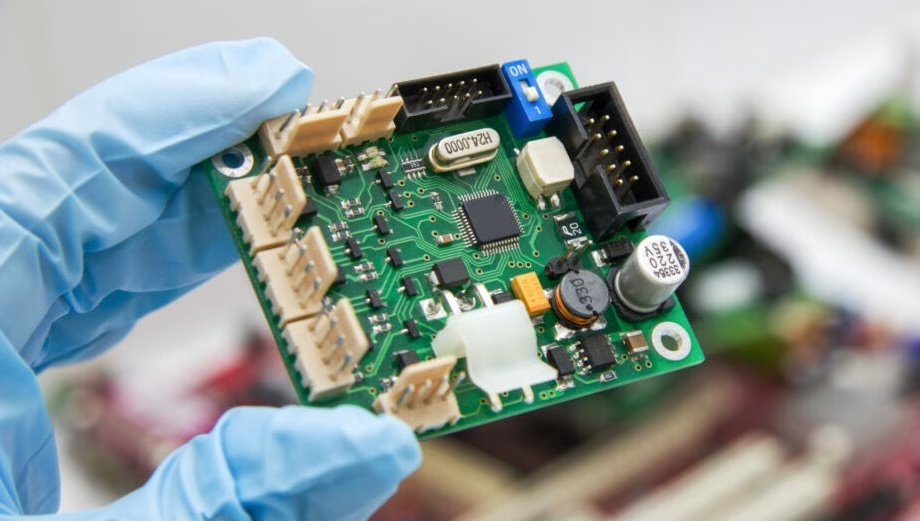

Monitor PCB Assembly2026-04-17T08:46:37+00:00

High-Performance Monitor PCB Solutions for Display Systems

OrinewPCB supports advanced PCB monitor fabrication from prototype to mass production. Our engineers assist in design, processing, and assembly to achieve stable display performance and reliable operation across diverse LCD and LED panel applications.

  • Supports LED, LCD, OLED, and custom panel configurations
  • Fine pitch SMT, through-hole, and mixed PCB assembly monitor
  • ISO 9001, IPC-A-610 Class 2 & 3, and RoHS certified production

GET YOUR QUOTE!

Click or drag a file to this area to upload.

What is a Monitor PCB?

A monitor PCB is a specialized printed circuit board that controls the core electrical functions of a display system. It manages signal input, power regulation, and data conversion while coordinating interface operations between the LCD panel, control buttons, and backlighting.

These boards integrate analog and digital circuits, microcontrollers, and passive components such as capacitors and transistors. Precision PCB design supports impedance control, thermal management, and accurate timing to maintain clear visuals and consistent display performance.

Our Monitor PCB Manufacturing and Assembly Capabilities

OrinewPCB combines advanced design review, precise fabrication, and rigorous testing to deliver reliable monitor PCBs that meet the electrical, mechanical, and interface demands of modern display applications.

We perform full design rule checks (DRC) and comprehensive PCB design process reviews using Gerber, PCB, or CAM files. Our engineering team verifies layer stack-ups, controlled impedance trace routing, and power plane separation. We support impedance matching tolerances of ±10% as standard, with ±5% available for high-speed and differential pair designs such as HDMI and DisplayPort signals used in 4K and 8K displays.

We use a selection of materials suitable for display PCB applications. Standard builds include FR4 with high glass transition temperatures (Tg ≥ 170°C) to support thermal stability during continuous use. Materials like Rogers, Panasonic Megtron, and Isola laminates are included for higher frequency and low-loss performance.

These support consistent signal transmission in HDMI, DisplayPort, and LVDS circuits. All materials meet RoHS requirements, and halogen-free options are part of our standard offering.

Our manufacturing processes achieve trace width and spacing down to 1.8 mil, with trace width tolerance of ±10%. Layer counts from 1 to 64 are supported. Laser-drilled microvias reach diameters as small as 3 mil with hole registration tolerances within ±30 µm.

Through-hole aspect ratios up to 40:1 are available for complex assemblies. SMT, through-hole, and mixed PCB assembly monitors are provided, supporting fine-pitch components including BGAs (down to 0.2 mm pitch) and QFPs (0.15 mm lead width). Reinforced mounting points and optimized layer alignment ensure mechanical durability over the display’s lifespan.

Every monitor PCB undergoes:

  • Automated Optical Inspection (AOI): Detects misalignments as small as 0.01 mm and solder defects down to 10 µm.
  • X-ray Inspection: Verifies hidden joints, including BGAs, with 99.7% connection accuracy.
  • Electrical Testing: Includes continuity and isolation checks, functional verification of display output, and signal integrity testing.
  • Flying Probe Testing: Accurate to ±5 µm for open/short detection.
  • Impedance Validation: Controlled impedance confirmed for high-speed signal paths up to 1 GHz bandwidth.

All testing is performed to IPC-A-600, IPC-A-610 Class 2 & 3, IPC-6012, RoHS, and, where required, JEDEC and IATF 16949 standards.

We provide laser-drilled microvias, blind vias, and buried vias suitable for high-density interconnects. Design tolerances are maintained across complex multilayer builds commonly used in 6 to 12-layer display applications requiring high data rate signal handling and power distribution integrity.

Our design and fabrication methods incorporate ground shielding, differential pair routing, and optimized stack-ups to suppress electromagnetic interference in high-frequency applications. Computer vision inspection methods are being adopted for fine-pitch assembly verification, ensuring accuracy beyond traditional AOI limits.

Features of Monitor PCBs

High Signal Integrity and Impedance Control

Monitor PCB boards use controlled impedance trace routing, differential pair matching, and continuous reference planes to maintain precise signal timing while minimizing reflections and crosstalk.

This supports accurate high-frequency signal transmission for HD and UHD display resolutions.

Advanced Thermal Management

Thermal vias, copper pours, and dedicated heat spreading layers dissipate heat from high-power components such as driver ICs and voltage regulators.

Careful PCB design reduces hot spots and maintains consistent thermal profiles, preventing output drift or premature component wear.

Low EMI and Noise Filtering

Multilayer stack-ups isolate high-speed signal layers from power and ground planes to reduce EMI coupling.

Filters and ferrite beads suppress noise, while shielded connectors maintain signal clarity even in noisy electrical environments.

Flexible Interface Support

Monitor PCB boards accommodate HDMI, VGA, DVI, and serial inputs.

Trace impedance and connector pad geometries are tuned to meet the electrical requirements of both digital and analog display signals while maintaining reliable functionality.

Durable Manufacturing and Materials

OrinewPCB uses high-quality FR4 and high-TG laminates with optimized resin systems to resist delamination and mechanical stress.

Precision fabrication supports fine trace geometries, controlled layer alignment, and reinforced mounting points for mechanical and electrical reliability over the display’s lifespan.

What are the Different Types of Monitor PCBs?

Different types of monitor PCBs perform specialized roles in managing signals, power, and user interaction across various display systems.
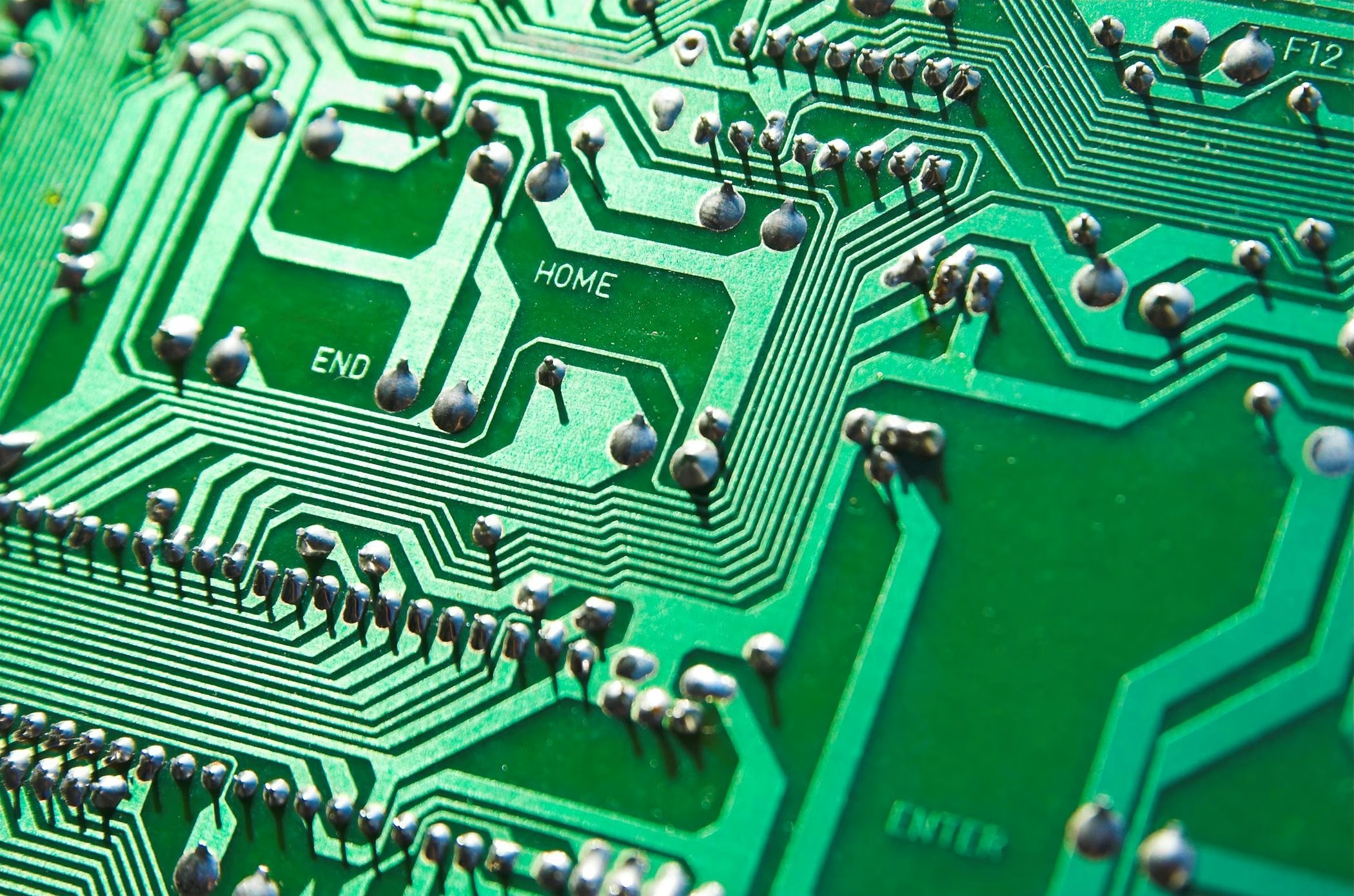
Controller Boards

These boards manage input signals from HDMI, VGA, DVI, or serial connections and convert them for processing by the display hardware. They handle scaling, timing, and synchronization for the LCD panel or LED display.

Backlight Driver Boards

Control power to LEDs or CCFL backlights, adjusting brightness and contrast. These PCB monitor boards regulate current and voltage to maintain consistent display illumination.

Power Supply Boards

Distribute regulated voltage levels across the monitor PCB, supporting components that require stable power for display operation, signal processing, and controller functions. 

Touch Interface Boards

Process signals from capacitive or resistive touch sensors, enabling touch functionality for monitors that require direct user input or navigation.

Menu and Button Boards

Support menu control, button press detection, and display adjustment features. They allow users to change settings like brightness, contrast, and input source manually or automatically.

What  are the Components of Monitor PCBs?

Monitor PCB assemblies combine key functional blocks and supporting electrical components to manage power, signal control, and display operations. Each component contributes to performance, stability, and user interface capability.

Microcontroller / Driver IC

Processes input signals and controls display functions such as brightness, resolution, and synchronization.

Capacitor 

Stabilizes voltage, filters electrical noise, and manages transient power events.

Transistor

Amplifies and switches signals within power and logic circuits.

Resistor 

Regulates current flow and adjusts voltage across circuits.

Diode

Blocks reverse current to protect components and maintain circuit stability.

Connector / Cable Interface

Links external input sources (HDMI, VGA, DVI, serial) to the monitor PCB board.

Backlight Driver IC

Controls current and voltage to LEDs or CCFL tubes for LCD panel illumination.

Memory Chip

Stores firmware, display profiles, and monitor settings.

Inductor

Filters high-frequency noise and stabilizes power delivery to sensitive components.

Button / Menu Switches

Detects button press inputs for menu navigation and display adjustment.

Voltage Regulator IC

Maintains consistent voltage levels for all onboard components.

Crystal Oscillator

Generates timing signals required for signal synchronization and functionality. 

LED Driver

Powers indicator LEDs and backlighting systems.

How Do Monitor PCBs Compare to Other Circuit Boards?

Property

Monitor PCB

Standard PCB

High-Frequency PCB

Signal Handling

Controlled impedance routing, differential pairs, and EMI reduction for clean signal transmission in display applications

Basic circuit routing with limited impedance control

Precision impedance and low-loss routing for RF and microwave signals

Power Management

Multi-voltage regulation supporting logic, backlight, and interface components

Simple voltage levels for general circuits

High-efficiency power regulation for specialized applications

Interface Complexity

HDMI, VGA, DVI, serial, and touch inputs supported

Basic connector support

Limited to specific RF or data interfaces

Thermal Management

Thermal vias, copper pours, and heat spreading layers for power component cooling

Minimal thermal design

Advanced cooling for high-power RF circuits

Durability and Reliability

High-quality materials, EMI shielding, and robust assembly for display operation

Standard materials with basic durability

Enhanced materials for thermal and mechanical reliability

Why Choose OrinewPCB as Your Monitor PCB Manufacturer?

Quality Standards and Production Control

Our monitor PCB production follows ISO 9001 and IPC-A-610 Class 2 & 3 standards, with traceability from PCB design validation to final inspection.

Each production lot undergoes documented process control and quality checks, covering design adherence, material verification, and in-process inspection.

For advanced display applications, we apply IPC-A-600, IPC-6012, and JEDEC standards where applicable, ensuring compliance with industry-recognized manufacturing and reliability benchmarks.

Advanced Engineering and Assembly Techniques

OrinewPCB supports high-density PCB monitor assembly using precision placement equipment for fine-pitch components, including BGAs, QFPs, and microcontrollers.

Impedance-controlled trace routing supports tolerances down to ±5% for differential pairs handling HDMI, DisplayPort, and high-speed serial data.

Our assembly tolerances maintain hole registration within ±30 µm and solder joint quality consistent with IPC acceptance criteria.

Trusted Materials and Sourcing Partnerships

We procure materials and components from authorized distributors, including Mouser, Digi-Key, Future Electronics, and WPG Holdings.

Supply chain validation excludes counterfeit parts and maintains full traceability from initial sourcing to final assembly.

All materials meet RoHS compliance and, when specified, adhere to additional environmental and performance standards.

Responsive Quoting and Scalable Production Capacity

OrinewPCB provides rapid quotations and supports both prototype and full production runs. Our flexible scheduling allows customers to scale from small batches to high-volume PCB assembly monitor PCB orders with minimal lead time.

Monitor PCB | FAQs

Designers must account for controlled impedance routing, thermal management, and interface compatibility. Proper PCB design supports signal integrity, stable voltage distribution, and mechanical durability across display applications.

Custom monitor PCB assemblies improve signal clarity, enable precise display control, and allow for flexible input configurations including HDMI, VGA, DVI, and serial connections.

Monitor PCB technology became standard in display systems during the 1980s as the industry transitioned from CRT to LCD and flat-panel displays. Early monitors used basic circuit boards with discrete components, managing analog signal control and simple power distribution.

As LCD panels and LED displays developed, monitor PCB boards integrated digital controllers, microprocessors, and firmware storage to improve functionality, precision, and reliability.

By the early 2000s, advances in PCB design, fabrication, and assembly allowed for compact multilayer boards supporting complex signal processing, adaptive voltage control, and advanced input interfaces such as HDMI, VGA, and DVI.

Each PCB monitor board undergoes AOI, X-ray, and electrical tests. We also verify signal integrity, power regulation, and functionality of the display output, using tools such as oscilloscopes and programmable power supplies.

Challenges include managing heat from high-power components, minimizing signal loss, and ensuring precise component placement. OrinewPCB addresses these through thermal vias, impedance control, and fine-pitch fabrication techniques.

Get Free Quote

Do you need help with PCB, PCB assembly, or electronic components? You can fill out and submit the form to leave your contact information (“*” indicates required fields)

GET YOUR QUOTE!

Click or drag a file to this area to upload.
Go to Top