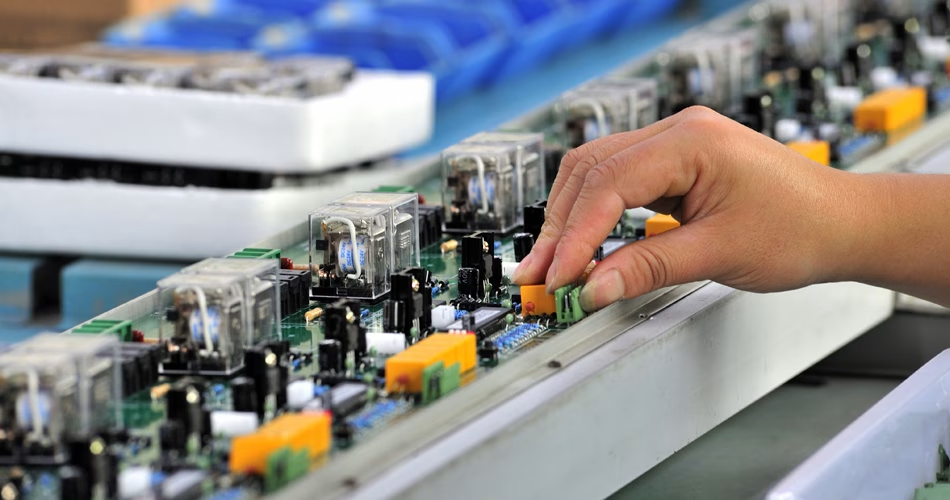

Power Bank PCB Assembly2026-04-17T09:29:01+00:00

Reliable Power Bank PCB Assembly Solutions

OrinewPCB specializes in the design, fabrication, and assembly of high-performance power bank PCBs engineered for efficient voltage conversion, robust circuit protection, and seamless integration of fast charging protocols (PD, QC 3.0) across diverse configurations, including 5V, Type-C USB, and multi-cell 18650 battery packs, supported by professional custom cable assembly solutions.

  • Advanced assembly including surface-mount (SMT), through-hole, and mixed technologies
  • High-current handling with copper thickness up to 1000 μm
  • Compliance with ISO 9001:2015, IPC-A-610H Class 3, and RoHS standards

GET YOUR QUOTE!

Click or drag a file to this area to upload.

What is a Power Bank PCB?

A power bank PCB (printed circuit board) is the central platform for power storage, voltage conversion, and energy delivery in portable charging devices. It integrates control logic, power regulation, protection circuitry, and interface components, enabling safe and efficient charging and discharging cycles.

Key functions of a power bank circuit board include:

Our Manufacturing Capabilities

OrinewPCB delivers power bank PCB solutions using advanced fabrication methods, precision assembly processes, and comprehensive quality control to meet the demanding requirements of portable power applications. Our facilities support the complete production cycle, from prototype development to high-volume manufacturing.

We manufacture power bank circuit boards with layer counts ranging from 1 to 50 layers, supporting both single-layer economical designs and complex multilayer architectures for high-performance modules.

Our material options include FR-4, high Tg FR-4, halogen-free laminates, CEM-3, polyimide, and aluminum substrates. The availability of polyimide and aluminum materials allows us to support designs requiring exceptional thermal performance or mechanical flexibility, including fast charging and high-capacity power banks.

Copper thickness options up to 1000 μm enable the creation of boards capable of handling significant current loads, essential for high-wattage outputs such as 65W, 100W, and multi-port fast charging applications. Our fabrication process supports fine trace and spacing geometries down to 1.8 mil, allowing for compact, high-density designs that incorporate complex circuit protection and control features without sacrificing board size or efficiency.

Surface finishes include leaded HASL, lead-free HASL, Immersion Gold (ENIG), OSP, Immersion Silver, and Hard Gold, ensuring reliable conductivity and durability under repeated use cycles.

Our assembly lines support surface mount technology (SMT) and through-hole assembly (THT), with the flexibility to perform single-sided, double-sided, or mixed technology builds.

We utilize high-precision placement equipment capable of handling component sizes down to 0.2 mm for BGAs and 0.15 mm/0.25 mm for QFP packages, achieving placement accuracies within ±30 μm. Our SMT lines achieve speeds up to 60,000 chips per hour, allowing for efficient production of prototypes and large production runs.

Quality assurance is a central part of our production process. All power bank PCBs undergo automated optical inspection (AOI) and X-ray evaluation to verify solder joint integrity and component placement.

Electrical testing—including flying probe and impedance testing—is applied to confirm signal continuity, isolation, and controlled impedance where required. Reliability testing covers critical areas such as solderability, thermal shock resistance, and hole wall integrity, ensuring that every board meets industry performance expectations.

Our processes and quality standards comply with ISO 9001:2015, ISO 14001:2015, IPC-A-610H Class 3, and RoHS directives. We are also UL certified, supporting product safety and regulatory compliance in global markets.

We offer flexible production schedules, with standard lead times of 5 to 6 days and expedited services capable of delivering fully assembled boards in as little as 24 to 48 hours.

Our capacity ranges from single prototypes (as low as one piece) to high-volume manufacturing, providing scalability to match the needs of startups, established manufacturers, and custom product developers.

Our power bank PCBs integrate industry-standard ICs and advanced protection systems. Charging controllers like the TP4056 manage constant current/constant voltage (CC/CV) charging with automatic termination.

Protection ICs such as the DW01-P, often paired with dual MOSFETs (e.g., FS8205A), provide overcharge (4.25V ±50mV), over-discharge (2.4V ±0.1V), and overcurrent safeguards.

Boost converters such as the XL6009 regulate voltage for outputs up to 20V or higher. At the same time, system-on-chip solutions like the IP5358 and IP5328P enable smart energy distribution, multiple fast-charging protocols, and load balancing across multiple USB outputs.

Features of Monitor PCBs

A power bank PCB integrates primary and supporting components that work together to manage power input, storage, regulation, and output while ensuring safety and efficiency. 

Battery Management IC

Controls charging and discharging, manages overcharge, over-discharge, and balances charging for multi-cell packs.

Boost Converter

Steps up battery voltage to stable output levels (5V, 9V, 12V, 20V).

USB Connectors

Interfaces include dual USB, Type-C, USB-C, micro USB, and legacy USB-A for power input/output.

MOSFETs

Handles high-current switching and load control.

Capacitors

Stabilizes voltage supply and reduces output ripple

Inductors

Works with the boost converter to regulate current flow and minimize electromagnetic interference (EMI).

Resistors

Limits current and sets voltage levels for control and feedback circuits.

Protection Circuits

Prevents overcharge, over-discharge, overcurrent, short-circuit, and reverse polarity damage.

LEDs / Display

Provides visual feedback for charge status, output voltage, and error indicators (LED display, LEDs).

Thermal Sensors

Monitors temperature to trigger cooling or shutdown in case of thermal overload.

Why Choose OrinewPCB As Your Power Bank PCB Fabrication Provider?
Certified Quality and
Process Control

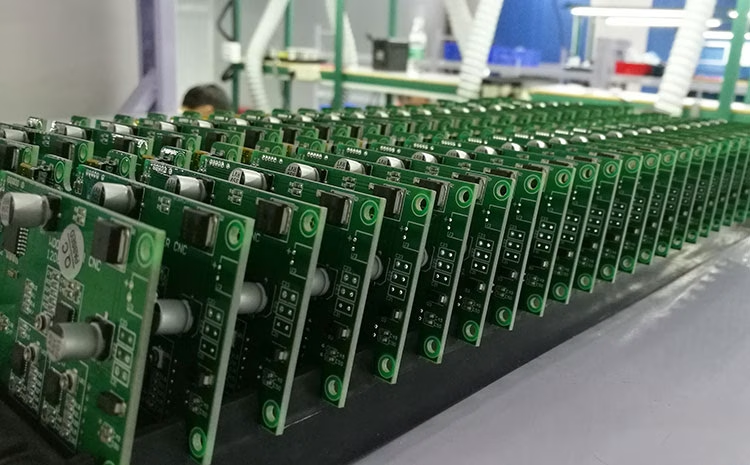
Our manufacturing and assembly processes adhere to ISO 9001:2015, ISO 14001:2015, IPC-A-610H Class 3, and RoHS standards. We maintain strict process controls from the initial DRC check through fabrication, assembly, and final testing.

By integrating UL-certified materials and advanced inspection technologies such as AOI and X-ray, we ensure that every power bank circuit board meets the mechanical, electrical, and safety criteria essential for reliable operation.

Engineering Expertise in
Power Bank Circuit Design

Our technical team has extensive experience with power bank PCB layouts, including high-current trace routing, controlled impedance, and compact designs that integrate fast charging protocols like PD, QC 3.0, and 65W or 100W outputs.

We address complex design challenges such as thermal management, balancing space constraints with efficient cooling solutions, and incorporating robust circuit protection for overcharge, discharge, and short-circuit conditions.

Verified Material
Sourcing

Our team provides fast quoting, transparent communication, and dedicated technical support. like Shengyi, Rogers, and Isola and surface finish chemicals from reputable brands.

For active and passive components—such as ICs, MOSFETs, capacitors, and connectors—we maintain partnerships with authorized distributors including Mouser, Digi-Key, Future Electronics, and WPG Holdings.

This approach ensures that every power bank PCB benefits from reliable materials and eliminates the risk of counterfeit parts. Consistent sourcing supports stable electrical performance, mechanical durability, and long production lifecycles.

Testing to Performance Standards

All power bank PCBs undergo rigorous electrical testing, including continuity, isolation, and impedance verification where required.

For power bank modules with advanced features such as fast charging or high-capacity battery packs, we also perform targeted reliability tests such as thermal cycling, charging and discharging validation, and component stress testing to confirm field performance.

Fast Quoting and Responsive Production

We provide quick, accurate quotations and flexible production scheduling.

Our team works closely with customers from initial design consultation through final assembly, offering technical feedback, design optimization recommendations, and support for prototype and volume production requirements.

Advanced Power Bank
PCB Technologies

Modern power bank PCBs incorporate advanced technologies to improve charging speed, device compatibility, and system efficiency. These innovations are essential for meeting the growing power demands of smartphones, tablets, laptops, and other portable electronics.

Cross-Section and X-ray Analysis

Our power bank circuit boards support industry-leading fast charging standards, including:

  • USB Power Delivery (PD): Dynamic voltage and current adjustments, enabling outputs like 5V, 9V, 12V, 15V, 20V, and up to 100W.
  • Qualcomm Quick Charge (QC 3.0) and QC 4.0: Allows rapid voltage stepping for efficient fast charging, reducing heat and charging time.
  • Support for proprietary protocols and dual compatibility (PD QC) where required.

These protocols ensure broad compatibility with smartphones, tablets, laptops, and mobile power banks while maintaining safe operating parameters.

Thermal Cycling and Thermal Shock Testing

Our power bank PCB designs also leverage the following integration technologies:

  • High-density PCB layout: Enables compact power bank module designs, reducing size without compromising performance.
  • Intelligent power management ICs: Dynamic current distribution, cell balancing (balancer circuits), and thermal regulation.
  • Smart load detection: Auto-adjusts output for connected devices, optimizing energy transfer.
  • Advanced circuit protection: Enhanced overcharge, over-discharge, overcurrent, and thermal protection with programmable thresholds.
  • Thermal management optimization: Use of high copper weights, thermal vias, and in some models, aluminum substrates for efficient heat dissipation.

These innovations improve energy conversion efficiency, extend battery life, and ensure compatibility with evolving fast-charging standards.

Types of Power Bank PCB Comparison

PCB Type

Max Current Handling

Thermal Performance

Size Efficiency

Cost Index

Fast Charging Support

Standard Power Bank PCB

Up to 2A

Moderate (FR-4, 1-2 oz copper)

High

Low

Basic (5V 1A/2A only)

Fast Charging PCB (PD/QC)

3A – 5A (up to 100W)

High (FR-4 or Polyimide, 2-4 oz copper)

Medium

Moderate

PD, QC 3.0, QC 4.0, 20W to 100W

High-Capacity PCB

5A+

Very High (Polyimide or Aluminum, up to 5 oz copper)

Variable

High

PD QC, Smart Load Detection

Rugged/Industrial PCB

3A – 10A

Very High (Aluminum or reinforced Polyimide)

Lower

Higher

Custom fast charging protocols

Common Power Bank PCB Materials

Selecting the appropriate materials is critical to ensuring the power bank PCB delivers reliable performance, thermal stability, and durability, especially under varying current loads and operating environments.

FR-4

The most commonly used printed circuit board substrate, FR-4, offers a balance of mechanical strength, electrical insulation, and cost-efficiency.

Suitable for most standard power bank circuit designs, FR-4 handles moderate thermal loads and supports 5V, 2A, and fast charging applications up to 65W. 

CEM-1

An economical alternative to FR-4, CEM-1 provides adequate performance for basic power bank modules requiring lower complexity and current capacity.

It’s often used in budget-friendly, single-layer power bank circuit boards.

Polyimide

Polyimide substrates offer superior thermal resistance, mechanical flexibility, and chemical stability.

Ideal for advanced or ruggedized power bank PCB designs that demand high temperature tolerance and flexible circuit integration, especially where fast charging generates additional heat.

Aluminum

Aluminum PCBs are used to prioritize heat dissipation and mechanical rigidity in power bank designs.

The metal core efficiently spreads heat away from power conversion components, improving the longevity and reliability of high-current power bank circuit boards, especially in fast charging models or dual USB 5V 2.4A outputs.

Power Bank PCB | FAQs

Power bank PCBs must incorporate multiple safety features to manage electrical, thermal, and mechanical risks. This includes protection against overcharge, over-discharge, overcurrent, and short circuits. Designs must also prevent reverse polarity and manage thermal buildup. Compliance with recognized industry safety standards, such as UL, CE, and FCC, is necessary to confirm that the board can operate reliably across expected load conditions and environmental factors.

We use precision circuit protection ICs and discrete components to control voltage and current limits. Multi-cell designs often include balancer circuits to prevent uneven charging and discharging among cells, especially in configurations using 18650 cells or lithium battery packs.

Our power bank PCBs are engineered with several methods to control and distribute heat. We use high copper weights (up to 20 OZ) to reduce trace resistance and improve thermal conductivity. Where appropriate, thermal vias are added beneath heat-generating components to transfer heat to other PCB layers or external heat sinks.

For higher power applications, such as fast charging modules (20W, 45W, 65W, or 100W), we may incorporate aluminum substrates or use polyimide materials with better thermal tolerance. Our design team optimizes component placement to minimize hotspots, and our manufacturing process includes plasma-treated surfaces and heat spreaders for advanced cooling where required.

All designs are validated through thermal cycling and stress testing during the development and production phases to verify effective heat management under operating conditions.

Yes. We can integrate LED display modules and microcontroller-based status indicators directly into the power bank PCB design. These features allow real-time battery voltage monitoring, current output, charge/discharge status, and temperature.

For designs requiring user controls, such as on/off switches or mode selection buttons, we can include appropriate circuitry and mechanical accommodations during the PCB layout phase.

We accept multiple file formats to streamline the manufacturing process. Customers can submit Gerber files (RS-274X preferred) and .pcb, .pcbdoc, and .cam files. Our engineering team performs a full design rule check (DRC) on all submitted designs.

If any manufacturability or compliance issues are detected, we collaborate with customers to resolve them before proceeding to fabrication and assembly.

Get Free Quote

Do you need help with PCB, PCB assembly, or electronic components? You can fill out and submit the form to leave your contact information (“*” indicates required fields)

GET YOUR QUOTE!

Click or drag a file to this area to upload.
Go to Top