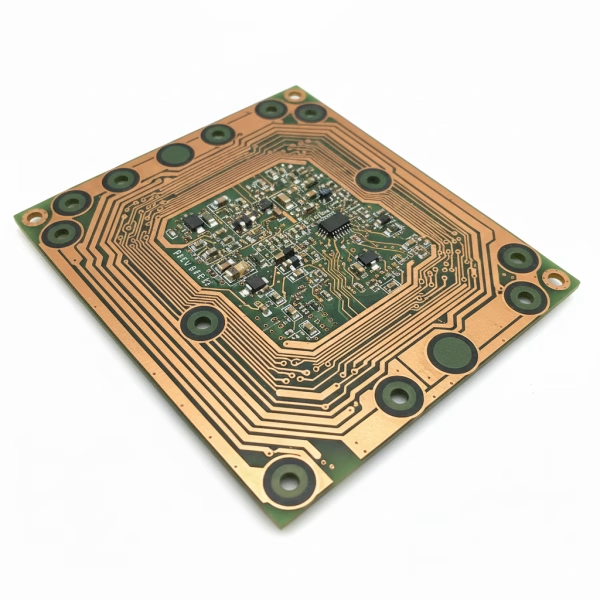

PTFE PCB Assembly2026-04-17T08:47:35+00:00

High-Frequency,Low-Loss PTFE PCB Assembly Solutions

OrinewPCB provides precision PTFE PCB assembly for high-frequency applications requiring mechanical stability, low dielectric constant, chemical resistance, and tight tolerances for performance and reliability. We assemble PTFE PCBs designed for consistent signal integrity and minimal signal loss across wide temperature and frequency ranges.

  • ISO 9001, IPC-A-610 Class 3, RoHS, and Lead-Free certified PCB assembly
  • Surface mount (SMT), through-hole, and mixed PCB assembly

GET YOUR QUOTE!

Click or drag a file to this area to upload.

What is PTFE?

PTFE, or polytetrafluoroethylene, is a synthetic fluoropolymer used as a PCB material in high-performance PCB manufacturing and PCB assembly. Its unique electrical properties, including a low dielectric constant between 2.17 and 2.40 and a low dissipation factor below 0.0015 at 10 GHz, allow PTFE PCB substrates to maintain signal integrity and minimize signal loss in high-frequency applications.

The chemical structure of polytetrafluoroethylene or PTFE provides non-reactivity, high thermal stability, and a low coefficient of friction, making it ideal for PCB fabrication requiring stability across wide frequency ranges and temperature extremes.

Our PTFE PCB Assembly Capabilities

We assemble PTFE PCBs fabricated from industry-recognized laminates sourced through our partner network. Materials include Rogers RO3003, RO4350B, and RO5880, which were selected for their stable dielectric values between 2.17 and 3.48 and loss tangents ranging from 0.0009 to 0.0037 at 10 GHz.
We also work with materials from Taconic, Isola, and Arlon. This allows flexibility in meeting design specifications for various high-frequency applications and performance thresholds.

For assemblies requiring post-fabrication drilling or via rework, our processes operate at spindle speeds between 180,000 and 250,000 RPM with feed rates of 20 to 60 micrometers per revolution.

Specialized drill geometries reduce mechanical stress and prevent edge deformation. Plasma surface conditioning using argon-based treatments improves copper adhesion inside hole walls, reducing the potential for separation or via failure during reflow or field operation.

When assembling stacked or multilayer builds, we coordinate with fabrication partners to verify lamination quality. Press cycles are confirmed with temperature ranges between 260°C and 290°C and pressures from 200 to 400 psi, depending on the stack-up and resin system.

Where appropriate, we specify glass-reinforced prepregs to minimize vertical expansion and maintain mechanical alignment during assembly.

Copper feature accuracy is validated before assembly, with strict control over trace geometries to maintain impedance consistency. Etch process records confirm copper thickness tolerances within ±5% of design values, supporting signal integrity for RF and microwave circuits.

Our assembly lines use nitrogen-purged reflow ovens to limit oxidation and improve solder wetting. This method enables lower peak soldering temperatures and reduces void formation.

Plasma-treated surfaces further enhance joint reliability. We monitor solder joint integrity throughout the assembly process to prevent defects affecting high-speed or high-frequency circuits.

Completed assemblies undergo automated optical inspection (AOI) and X-ray evaluation. Electrical tests verify continuity and isolation. Where required, impedance testing, including time-domain reflectometry (TDR), is used to confirm transmission line consistency at frequencies up to 77 GHz, meeting RF performance specifications.

For builds requiring microvias or complex interconnects, we coordinate laser drilling using CO₂ or UV systems with controlled pulse energy settings. Laser parameters are selected based on laminate filler content and reinforcement to produce clean, precise vias without damaging the surrounding material.

All assembly operations comply with ISO 9001, IPC-A-610 Class 3, and RoHS directives. Assemblies designed for automotive, aerospace, or defense applications follow additional industry standards specified by customer requirements.

Where are PTFE PCBs Used?

Aerospace and Satellite Communications

PTFE PCBs maintain signal integrity and resist thermal expansion in avionics, radar, and satellite systems operating across extreme altitudes and wide frequency ranges.
Their low dielectric constant and loss minimize signal loss, supporting reliable data transmission.

RF and Microwave Systems

RF and microwave applications depend on PTFE PCBs for a low dissipation factor and minimal loss at frequencies exceeding 10 GHz.

The high dielectric stability of Teflon PCB materials allows consistent impedance control, which supports the reliable operation of high-frequency circuits and high-speed signal routing.

Medical Imaging Equipment

PTFE PCB material is used in MRI coils, RF amplifiers, and other medical devices where thermal stability and chemical resistance prevent performance degradation over time and repeated sterilization cycles.

Industrial Sensor Networks

In chemical processing and industrial automation, PTFE PCBs withstand high temperatures, moisture, and exposure to reactive substances.

PTFE’s non-reactivity and low coefficient of friction reduce material wear and thermal expansion effects.

Automotive Radar and ADAS

High-frequency PCB assemblies using PTFE laminates support vehicle radar, LIDAR, and adaptive cruise control, where signal integrity and thermal stability are critical under variable operating conditions.

High-Frequency Test Equipment

PTFE printed circuit boards are essential in testing instruments designed to measure and verify high-frequency circuits, providing 

consistent electrical properties with minimal variability.

Why Choose OrinewPCB for Your PTFE PCB Assembly?
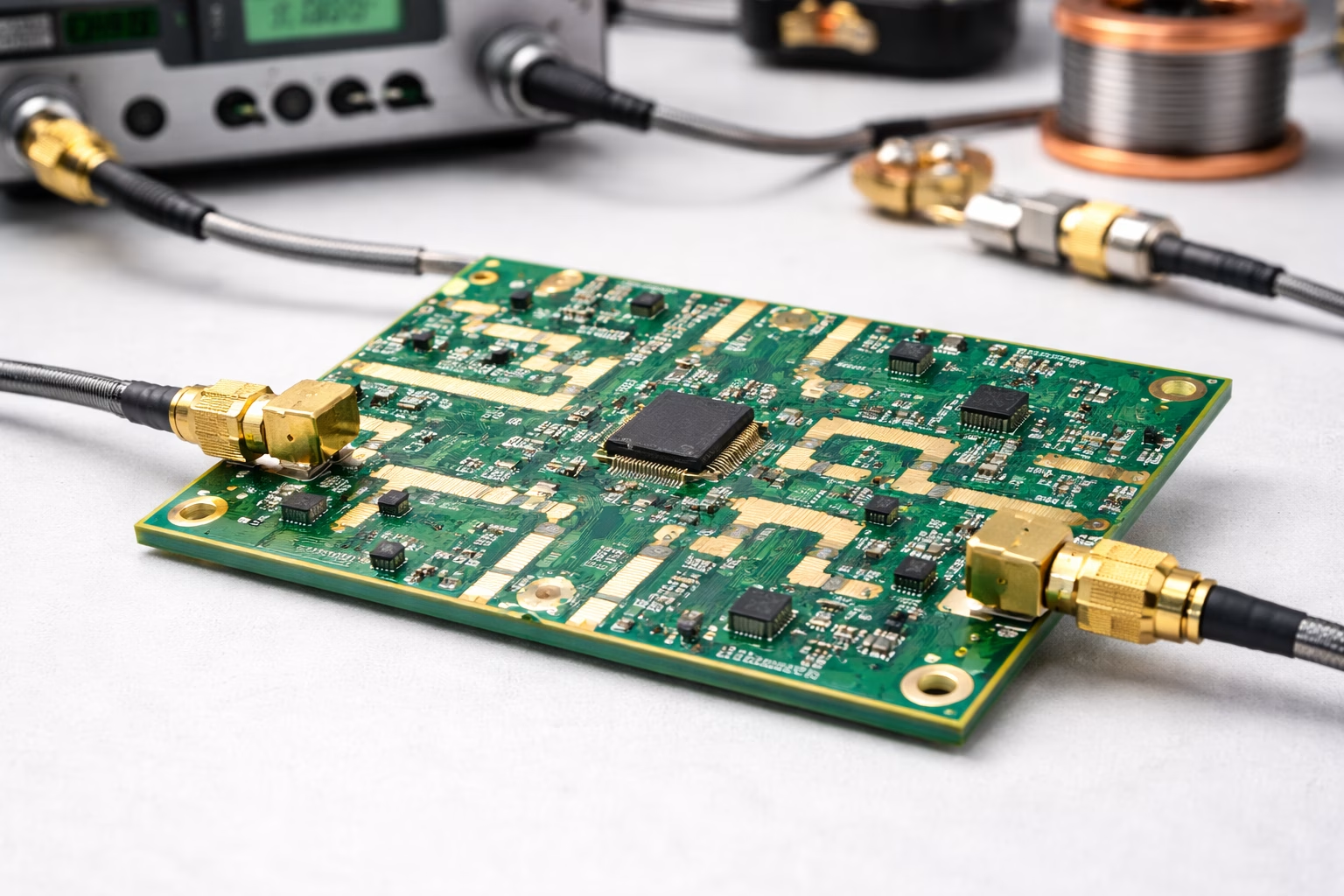
Certified Quality and Process Control

Our assembly facilities operate under ISO 9001 certification with IPC-A-610 Class 3 workmanship standards.

Every PCB assembly follows documented process controls designed to meet the reliability expectations of industries such as aerospace, telecommunications, and advanced test systems.

Engineering Expertise in PTFE Assembly

Our team has extensive experience with Teflon PCB builds, including handling, placement, and soldering techniques tailored to minimize material stress.

We address process challenges such as low surface energy and dimensional movement during reflow.

Verified Material Sourcing

We work with fabricators using premium PTFE PCB materials from Rogers, Taconic, Isola, and Arlon.

This supports consistent performance across various designs, from simple prototypes to complex multilayer PCB boards requiring fine-pitch components and controlled impedance routing.

Testing to Performance Standards

All assemblies undergo optical and X-ray inspection, with electrical testing for continuity and isolation.

For RF performance requirements, we offer impedance validation and advanced signal verification techniques to confirm consistency across the intended frequency range.

Fast Quoting and Responsive Production

OrinewPCB provides detailed quotations and design feedback to support project timelines.

Our assembly services cover prototype and full production requirements, with flexibility for customer-supplied or turnkey component sourcing.

Features of PTFE PCBs

PTFE PCB assembly supports advanced circuit designs by combining consistent dielectric behavior with mechanical and chemical resilience. Key performance traits include:

Low Dielectric Constant and Minimal Signal Loss

PTFE PCBs maintain a low dielectric constant, usually between 2.17 and 2.40, stabilizing impedance and minimizing signal delays.

This reduces reflection and signal loss, which is important for high-frequency applications and RF and microwave designs.

The uniform molecular structure of PTFE limits polarization effects at high frequencies, allowing accurate transmission line performance and reduced phase distortion.

Dimensional Stability

PTFE PCBs offer reliable dimensional consistency, even in varying humidity and temperature environments.

Reinforced material types, such as glass or ceramic-filled options, improve strength and reduce the risk of warping during assembly or operation.

These reinforcements also control movement during lamination, preserving precise trace alignment and maintaining consistent line widths that support controlled impedance performance.

Moisture Resistance and Chemical Durability

The non-reactive surface of PTFE repels moisture and resists damage from aggressive chemicals.

This protects PCB assemblies in applications where exposure to humidity or reactive substances can degrade circuit performance.

The fluorine-carbon bond in PTFE provides stability against oxidation and prevents chemical infiltration, even in harsh industrial or aerospace environments.

Heat Tolerance and High-Speed Compatibility

PTFE PCBs support high-speed signal routing without degradation in demanding environments.

Their stability under wide operating conditions, typically from -50°C to +150°C, allows integration into complex high-frequency circuits where reliable signal transmission is required.

The consistent material behavior across this temperature range prevents shifts in dielectric response, preserving signal timing and reducing insertion loss.

How does PTFE Compare to Other PCB Materials?

PTFE PCB assembly offers performance advantages over standard materials like FR4 and ceramic-based substrates, particularly for high-frequency applications.

Property

PTFE

Rogers (RO4350B / RO3003)

Arlon (AD255C / CuClad)

Isola (IS620 / IS680)

Taconic (RF-35 / TLY-5A)

FR4

Ceramic Substrates

Dielectric Constant

2.17 – 2.40

3.38 (RO4350B) to 3.00 (RO3003)

2.55 (AD255C) to 2.17 (CuClad)

3.38 (IS680) to 3.45 (IS620)

2.20 (RF-35) to 2.17 (TLY-5A)

4.2 – 4.7

6.0 – 10.0

Loss Tangent

< 0.0015

0.0037 (RO4350B) to 0.0010 (RO3003)

0.0015 (AD255C) to 0.0009 (CuClad)

0.0035 (IS680) to 0.0050 (IS620)

0.0018 (RF-35) to 0.0011 (TLY-5A)

0.018 – 0.025

0.0005 – 0.003

Moisture Absorption

< 0.01%

< 0.06%

< 0.04%

< 0.10%

< 0.02%

0.10% – 0.20%

Negligible

Processing Complexity

Advanced lamination and surface treatments are needed

Requires advanced lamination and surface treatments

Requires advanced lamination and surface treatments

Requires advanced lamination and surface treatments

Requires advanced lamination and surface treatments

Standard PCB fabrication

Difficult, requires specialized tooling

Cost Cost

Higher

Higher

Higher

Higher

Higher

Lower

Higher

Use in High Frequencies

Ideal for high-frequency applications

Ideal for high-frequency applications

Ideal for high-frequency applications

Ideal for high-frequency applications

Ideal for high-frequency applications

Limited by dielectric loss

Suitable but expensive

Teflon PCB Fabricator | FAQs

Designers should consider material handling challenges, including adhesion properties and dimensional control. Clearances, pad sizes, and via structures must accommodate potential movement during soldering and assembly.

PTFE PCBs offer a low dielectric constant and minimal signal loss, supporting high-frequency applications where impedance stability and reduced phase distortion are important.

PTFE surfaces require plasma treatment or chemical conditioning to improve solder adhesion. Soldering in nitrogen environments reduces oxidation and promotes reliable joint formation without excessive thermal stress.

PTFE assemblies can face adhesion issues due to the material’s low surface energy, leading to pad separation or poor solder joint formation. Plasma surface treatments are applied to increase wettability before assembly.

Via deformation and drilling burrs may occur because of the material’s softness and elasticity; these are controlled by using high-RPM drilling with optimized chip loads and post-drill cleaning. During reflow, dimensional movement can cause trace misalignment. This is managed through controlled temperature ramp rates, fixture support, and reinforced laminate selection when appropriate.

Polytetrafluoroethylene (PTFE) was discovered in 1938 by Dr. Roy J. Plunkett during experiments with tetrafluoroethylene gas. The accidental polymerization produced a solid material with a low dielectric constant, high thermal stability, and strong chemical resistance.

These properties, combined with its low coefficient of friction, led to the development of PTFE material for electrical insulation and, eventually, for PCB substrates in RF and microwave systems.

By the 1950s, the use of Teflon expanded into high-frequency transmission lines and advanced circuit boards. The ability of PTFE PCBs to support consistent electrical properties across a wide frequency range made them suitable for demanding high-frequency applications.

Over time, processing techniques evolved to address difficulties in processing, including adhesion challenges and managing the coefficient of thermal expansion during PCB fabrication and PCB assembly. Today, Teflon PCB materials remain a standard for high-frequency circuits requiring stable performance in extreme conditions.

Get Free Quote

Do you need help with PCB, PCB assembly, or electronic components? You can fill out and submit the form to leave your contact information (“*” indicates required fields)

GET YOUR QUOTE!

Click or drag a file to this area to upload.
Go to Top