

What is HDI PCB?
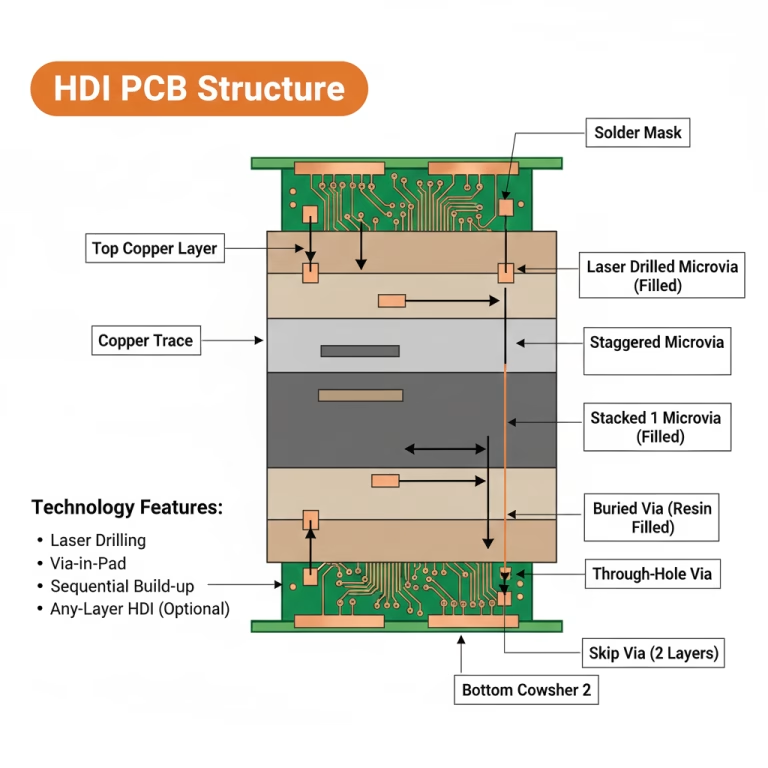
HDI stands for High Density Interconnector. A circuit board which has a higher wiring density per unit area as opposed to conventional board is called as HDI PCB. HDI PCBs have finer spaces and lines, minor vias and capture pads and higher connection pad density. It is helpful in enhancing electrical performance and reduction in weight and size of the equipment. HDI PCB is the better option for high-layer count and costly laminated boards.
The emergence of HDI technology has propelled the development of the PCB industry by enabling the integration of denser components like BGAs and QFPs.
HDI PCB Applications
HDI PCBs are predominantly used in high-end electronic devices such as communication equipment, computers, medical devices, and automobiles. Their high density, reliability, and superior performance make them critical in these applications.
Key HDI PCB Benefits
The Evolution of HDI Technology: Empowering Next-Gen Design Flexibility
The advancement of High-Density Interconnect (HDI) technology has unlocked unprecedented design freedom for hardware engineers. By leveraging HDI methodologies, designers can now maximize component density through double-sided mounting on the raw PCB. This high-density architecture provides more “functional real estate,” allowing for the integration of smaller, sophisticated components in a tighter footprint. Consequently, HDI PCBs significantly shorten signal paths, which minimizes parasitic interference and results in superior signal integrity and ultra-fast transmission speeds.
Beyond performance, HDI is the primary driver for miniaturization and weight reduction in modern electronics. While traditionally found in smartphones, laptops, and 4G/5G communications, its footprint has expanded into mission-critical sectors. Today, HDI technology is indispensable in high-resolution medical imaging, wearable healthcare tech, and aerospace avionics. As we move toward more complex IoT and AI-driven hardware, the potential of high-density interconnects remains virtually limitless.
We’re capable of manufacturing HDI PCB up to 24 layers in various structures, check the following table for our available HDI PCB structures:
| HDI Structures |
Type of Micro vias |
Mass Production |
Small-Middle Batch |
Prototype | Available |
| 1+N+1 | Blind vias | Yes | Yes | Yes | 4 layers+ |
| 2+N+2 | Blind/Buried staggered vias |
Yes | Yes | Yes | 6 layers+ |
| 2+N+2 | Blind/Buried stacked vias |
Yes | Yes | Yes | 6 layers+ |
| 3+N+3 | Blind/Buried staggered vias |
/ | Yes | Yes | 8 layers+ |
| 3+N+3 | Blind/Buried stacked vias |
/ | / | Yes | 8 layers+ |
Check our HDI PCB capabilities by reviewing the table found below:
| Feature | Capability |
| Quality Grade | Standard IPC 2 |
| Number of Layers | 4 – 24layers |
| Order Quantity | 1pc – 10000+pcs |
| Build Time | 2days – 5weeks |
| Material | FR4 standard Tg 140°C,FR4 High Tg 170°C, FR4 and Rogers combined lamination |
| Board Size | Min 6*6mm | Max 457*610mm |
| Board Thickness | 0.4mm – 3.0mm |
| Copper Weight (Finished) | 0.5oz – 2.0oz |
| Min Tracing/Spacing | 2.5mil/2.5mil |
| Solder Mask Sides | As per the file |
| Solder Mask Color | Green, White, Blue, Black, Red, Yellow |
| Silkscreen Sides | As per the file |
| Silkscreen Color | White, Black, Yellow |
| Surface Finish | HASL – Hot Air Solder Leveling Lead Free HASL – RoHS ENIG – Electroless Nickle/Immersion Gold – RoHS Immersion Silver – RoHS Immersion Tin – RoHS OSP – Organic Solderability Preservatives – RoHS |
| Min Annular Ring | 4mil, 3mil – laser drill |
| Min Drilling Hole Diameter | 6mil, 4mil – laser drill |
| Max Exponents of Blind/Buried Vias | stacked vias for 3 layers interconnected, staggered vias for 4 layers interconnected |
| Other Techniques | Flex-rigid combination Via In Pad Buried Capacitor (only for Prototype PCB total area ≤1m²) |